
Quick answer
- Australia and Canada suit students who want strong work rights and a possible long-term pathway, but both now check applications more strictly.
- The UK is the fastest route to a master's degree (often one year), but post-study work is shrinking from 2027.
- The USA offers the widest choice of universities and strong STEM opportunities, with an in-person visa interview.
- New Zealand offers good work rights and a calmer, smaller market.
- Europe (especially Germany) can be the most affordable option for engineering and technology.
Every year thousands of students from Ahmedabad and across Gujarat head overseas for their bachelor's or master's degree. But the rules keep changing, and the "best" country in 2023 may not be the best choice for you in 2026. This guide compares the six most popular destinations side by side, so you and your family can make an informed decision.
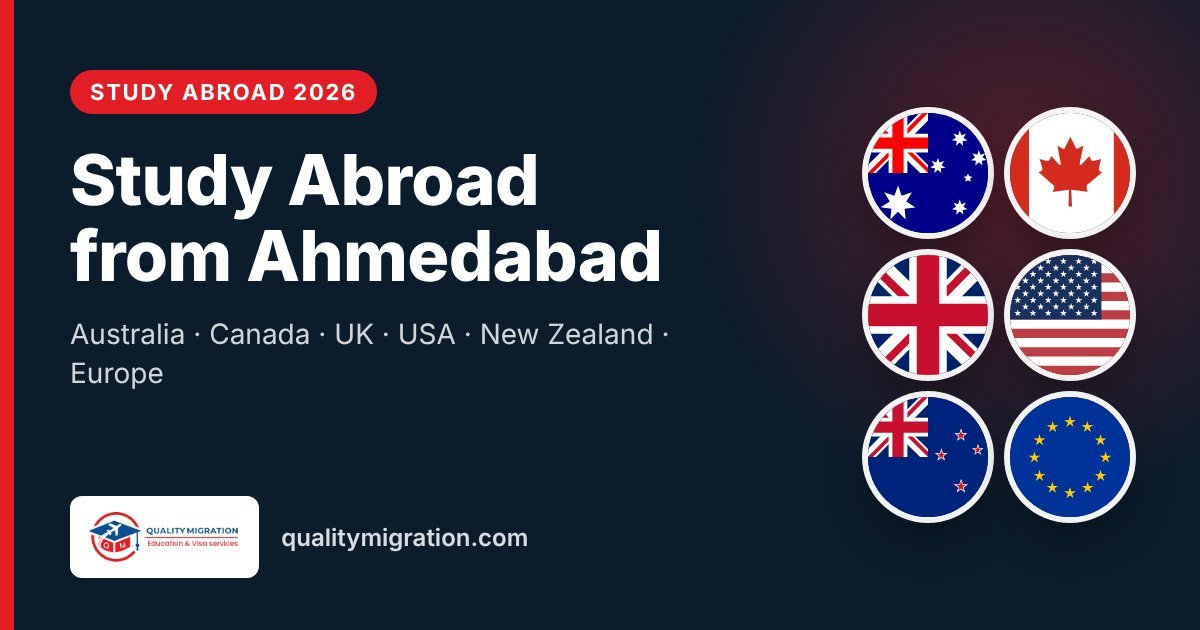
Side-by-side comparison for 2026
| Country | Main visa | Work during study | After graduation | Main intakes |
|---|---|---|---|---|
| Australia | Student visa (subclass 500) — fee AUD 2,500 | 48 hours per fortnight in term, unlimited in breaks | Temporary Graduate visa (485), usually 2 years after a bachelor's or coursework master's | February, July |
| Canada | Study permit (most students need a PAL/TAL) | Up to 24 hours a week off campus during sessions | Post-Graduation Work Permit (PGWP) for eligible programmes | September, January, May |
| UK | Student visa with a CAS from a licensed university | Up to 20 hours a week in term for degree-level study | Graduate Route — 2 years now, 18 months for applications from 1 January 2027 | September, January |
| USA | F-1 visa with Form I-20; in-person interview | On-campus work, usually up to 20 hours a week in term | Optional Practical Training (OPT), with a STEM extension for eligible degrees | Fall (Aug/Sep), Spring (Jan) |
| New Zealand | Fee Paying Student Visa | Up to 25 hours a week for eligible students | Post-study work visa for eligible qualifications | February, July |
| Europe | National student visa of your chosen country | Varies by country | Varies — e.g. job-seeker permits in Germany, Stamp 1G in Ireland | Sep/Oct, Feb/Mar |
Australia: strong lifestyle and work rights, stricter checks
Australia remains a favourite for Gujarati students thanks to its large Indian community, part-time work rights and the 485 post-study visa. However, from January 2026 India was moved to Evidence Level 3, which means more financial and English evidence and closer checks. You will need to meet the Genuine Student requirement and show at least AUD 29,710 a year for living costs plus tuition and travel.
Best for: nursing, IT, engineering, accounting and early childhood education. See our Australia student visa page.
Canada: fewer permits, but master's students benefit
Canada expects to issue up to 408,000 study permits in 2026, down from previous years. Most applicants still need a Provincial or Territorial Attestation Letter (PAL/TAL), but from 2026 master's and doctoral students at public institutions are exempt. Choose your college or university and programme carefully, because PGWP eligibility depends on it.
Read our detailed Canada 2026 guide or our Study in Canada page.
UK: one-year master's, but shorter post-study work from 2027
Many UK master's degrees take just 12 months, which keeps total costs down. You'll need a CAS, a tuberculosis test certificate and funds held for the required period — currently £1,529 a month in London or £1,171 a month elsewhere (for up to nine months), plus tuition. The Graduate Route currently gives two years after a bachelor's or master's, reducing to 18 months for applications made from 1 January 2027. Only postgraduate research students can usually bring dependants.
USA: widest choice, interview is key
The USA has thousands of universities and is especially strong for computer science, data science and engineering. After receiving your I-20, you pay the SEVIS fee, complete the DS-160 and attend a visa interview at a US Embassy or Consulate in India. Most applicants now need an in-person interview, so preparation matters. STEM graduates may be eligible for OPT with a STEM extension.
New Zealand: practical courses and good work rights
New Zealand increased student work rights to 25 hours a week for eligible students and offers post-study work visas for eligible qualifications. Students usually need to show around NZ$20,000 per year of study for living costs.
Explore studying in New Zealand.
Europe: affordable quality, especially Germany
Public universities in Germany charge low or no tuition fees for many programmes. Indian students need an APS certificate and usually a blocked account to show living costs. Ireland, France and the Netherlands are also popular, with many English-taught programmes.
How to choose the right country
- Start with your course and career goal, not the country. Some fields (nursing, teaching) need local registration.
- Work out your total budget — tuition, living costs, visa fees, insurance and flights — and how it will be funded (savings, family income, education loan).
- Check your academic profile and gaps. Long study gaps need a clear, honest explanation in every country.
- Get the right English score for both the university and the visa.
- Think about life after graduation — post-study work rights differ a lot between countries.
Common mistakes Gujarati students make
- Choosing a course only because an agent says it leads to PR.
- Showing large, unexplained deposits in bank accounts shortly before applying.
- Writing a generic statement of purpose copied from the internet.
- Applying too close to the intake date.
Frequently asked questions
Which country is cheapest for Indian students in 2026?
Germany is often the most affordable because many public universities charge low or no tuition fees. Among English-speaking countries, total cost depends mostly on your course and city.
Which country is easiest for a student visa?
No country is "easy" — each checks whether you are a genuine student with enough funds. The best choice is the country where your course, budget and documents fit the rules.
Can I work while studying?
Yes, in all six destinations, within limits — for example 48 hours per fortnight in Australia, 24 hours a week in Canada and 20 hours a week in the UK during term.
Our Ahmedabad office at Town Plaza, Nikol helps students compare options, apply to universities and prepare complete visa applications. Book a free counselling session.